
Skip to content

Citizenship

The B1 German requirement for naturalisation

Naturalisation is the reason most people finally book a B1 exam. The language requirement itself is simple - B1 in all four skills, proven with a certificate the authority accepts - but the rules around it changed twice in eighteen months, and a lot of advice online is now out of date.

You need B1How to reach B1Checked July 2026
Language level
B1 (§ 10 Abs. 1 Nr. 6 StAG)
Residence required
5 years, for everyone
Married to a German
Usually 3 years residence + 2 years marriage
Separate knowledge test
Einbürgerungstest, 33 questions, 17 correct to pass
Dual citizenship
Permitted since June 2024
Typical processing time
6-18 months, depending on the city

Who this applies to

  • Anyone applying for German citizenship by naturalisation under § 10 StAG.
  • Spouses and registered partners of German citizens applying under the easier route.
  • Long-term residents who have held a permit for at least five years and want to stop renewing it.
  • Parents naturalising minor children together with their own application.

Which certificates are accepted

  • Deutsch-Test für Zuwanderer (DTZ) with a B1 result
  • Zertifikat Integrationskurs - the certificate you receive for passing the DTZ at B1 plus the "Leben in Deutschland" test
  • Goethe-Zertifikat B1, telc Deutsch B1 or ÖSD Zertifikat B1
  • Any certificate above B1 - B2, C1 and C2 all satisfy the requirement
  • A German school leaving certificate, a completed German apprenticeship or a German university degree, in the practice of most authorities

PassDeutsch prepares you for the B1 exams named here - Goethe, telc and the DTZ - with full-length model tests in each provider’s own format. See the B1 guide.

Exceptions and special cases

Where the rule works differently

These are the situations that most often change the answer. None of them replaces advice on your own file.

The three-year route no longer exists

The 2024 reform allowed naturalisation after three years for "besondere Integrationsleistungen", which usually meant C1 German. That route was abolished with effect from 30 October 2025. Five years is now the minimum for everybody, and C1 no longer shortens it.
Spouses of German citizens

The easier route under § 9 StAG continues: as a rule three years of lawful residence and two years of marriage, with the same B1 requirement and the same other conditions.

The guest-worker generation

People who came to West Germany as guest workers before 1974, or to the GDR as contract workers, are held to an eased language standard - the ability to communicate orally in everyday life - and are exempt from the Einbürgerungstest.

Illness, disability and old age

Where a physical or mental illness or a disability makes reaching B1 impossible, the requirement can be waived on presentation of a medical certificate. This is decided case by case.

Step by step

How the process runs

  1. 1

    Check the five years first

    Count lawful, habitual residence in Germany with a qualifying permit. Time on a student permit and time spent in the asylum procedure count differently depending on the case, so if your history is complicated, get the count confirmed before you pay for anything.

  2. 2

    Sit a B1 exam and keep the certificate

    DTZ, Goethe, telc and ÖSD all satisfy the requirement, so take whichever you can book soonest. If you are in an integration course, the DTZ is already scheduled for you - just make sure you land at B1 and not A2 in both parts.

  3. 3

    Pass the Einbürgerungstest

    Thirty-three multiple-choice questions on law, history and society, of which you need seventeen correct. It is a separate test from the language exam, it is booked separately, and the full question catalogue is published in advance.

  4. 4

    Apply and wait

    The application goes to your local naturalisation authority with your certificates, proof of income, identity documents and residence history. The fee is €255 for an adult. Processing runs from a few months to well over a year depending on the city.

Get the B1 certificate

B1 is about 2,400 words, the passive and Konjunktiv II - a finite target. PassDeutsch gives you full model tests in the Goethe, telc and DTZ formats, with AI feedback on writing and speaking.

Free to download · all 210 model tests included

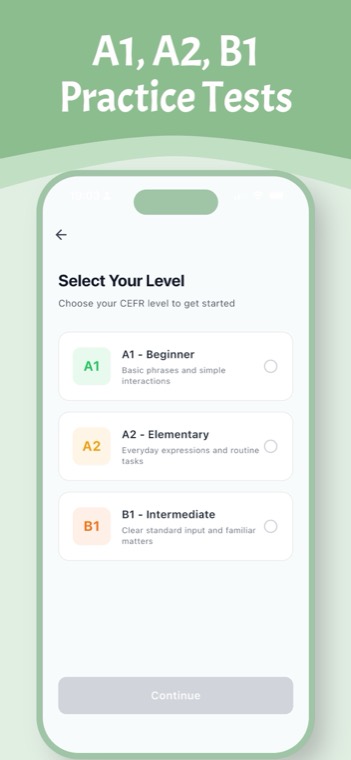
Choosing CEFR level B1 in the PassDeutsch app

What goes wrong

Three things that cost people months

An A2 result on the DTZ

The DTZ is scaled, so there is no "fail" - but an A2 result on either the written or the oral part does not meet the B1 requirement. Check both lines on the certificate.

Relying on advice written before November 2025

Guides that still describe naturalisation after three years with C1 German are describing a rule that no longer exists. Check the publication date of anything you read, including this page.

Assuming the language test covers the knowledge test

They are separate. B1 proves your German; the Einbürgerungstest proves your knowledge of the legal and social order. You need both.

FAQ

B1 for naturalisation: common questions

Which German certificate do I need for citizenship?

A B1 certificate in all four skills. The authorities accept the DTZ with a B1 result, the Zertifikat Integrationskurs, and Goethe-Zertifikat B1, telc Deutsch B1 or ÖSD Zertifikat B1 - as well as any higher level. A German school leaving certificate or degree is generally accepted in place of a language exam.

Can I still get citizenship after three years with C1 German?

No. That route was abolished with effect from 30 October 2025. Five years of lawful residence is now the minimum for everyone, apart from the separate rules for spouses of German citizens. C1 German no longer shortens the waiting period.

Do I have to give up my current citizenship?

No. Multiple citizenship has been permitted since the reform came into force in June 2024, and that part of the reform was not reversed. Whether your country of origin allows you to keep its nationality is a separate question for that country.

Is the Einbürgerungstest in German?

Yes, and there is no dictionary. That is one reason the B1 exam is worth taking first: at B1 the questions are readable. The full catalogue of questions is published, so the test is very trainable.

Start preparing for B1 today

Download PassDeutsch, sit a full model test in the format you will actually take, and find out how far you are from the level your application needs.

Free to download · All 210 model tests included · No card required