
Skip to content

A1 · A2 · B1 · model tests

Goethe-Zertifikat preparation: A1, A2 and B1

The Goethe-Zertifikat is the German language certificate issued by the Goethe-Institut and is recognised almost everywhere a German qualification is asked for - university applications, employers, visa files and family reunification. PassDeutsch gives you full-length Goethe model tests at A1, A2 and B1 with the same four modules, the same task types and a timer that runs the way the real exam does.

What the Goethe exam is

  • The Goethe-Institut is Germany’s cultural institute, with exam centres in more than 90 countries.
  • Its exams follow the CEFR (Common European Framework of Reference), so an A1, A2 or B1 certificate means the same thing everywhere.
  • Every exam tests four skills: Hören (listening), Lesen (reading), Schreiben (writing) and Sprechen (speaking).
  • Certificates do not officially expire, although institutions often ask for a result no older than one or two years.

Who usually takes it

  • Applicants for a spouse or family reunification visa, where A1 is the usual minimum.
  • Students preparing for a Studienkolleg, university pathway or apprenticeship in Germany.
  • Professionals whose employer or recognition authority asks for a specific CEFR level.
  • Learners who want an internationally recognised certificate rather than an internal course test.

Commonly accepted for

  • Visa and residence applications at German missions abroad
  • University, Studienkolleg and vocational-training applications
  • Employers and professional-recognition bodies (Anerkennung)
  • Proof of language progress for scholarships and exchange programmes

Exam format

Goethe structure, module by module

Durations and part counts are approximate - your test centre gives you the binding version when you book.

A1

Goethe-Zertifikat A1: Start Deutsch 1

The entry-level exam. You show that you can understand and use everyday expressions, introduce yourself, fill in simple forms and write a short message.

ModuleTimePartsWhat you do
HörenListeningapprox. 20 min3 partsShort announcements, phone messages and public announcements with multiple-choice and true/false items.
LesenReadingapprox. 25 min3 partsShort emails, small ads, signs and notices - matching and true/false questions.
SchreibenWritingapprox. 20 min2 partsComplete a simple form, then write a short personal message of about 30 words.
SprechenSpeakingapprox. 15 min3 partsIntroduce yourself, ask and answer questions from keyword cards, make and respond to simple requests.

Note: Sprechen is usually taken in a group of up to four candidates.
A2

Goethe-Zertifikat A2

You show that you can cope with routine situations: understanding announcements and short articles, writing a simple message and talking about everyday topics.

ModuleTimePartsWhat you do
HörenListeningapprox. 30 min4 partsEveryday conversations, radio announcements and short interviews.
LesenReadingapprox. 30 min4 partsEmails, newspaper snippets, adverts and notices with matching and multiple-choice items.
SchreibenWritingapprox. 30 min2 partsAn informal message (about 30 words) and a short semi-formal reply (about 30–40 words).
SprechenSpeakingapprox. 15 min3 partsAsk and answer questions about yourself, talk about your daily life, and agree on something with your partner.

Note: Sprechen is taken in pairs.

B1

Goethe-Zertifikat B1

The level most people actually need: it is the usual requirement for permanent residence and naturalisation and the point at which you can handle work and study situations in German.

ModuleTimePartsWhat you do
LesenReadingapprox. 65 min5 partsBlog posts, formal letters, opinion texts, adverts and regulations - multiple choice, matching and true/false.
HörenListeningapprox. 40 min4 partsEveryday conversations, radio features, a talk and a discussion, some played only once.
SchreibenWritingapprox. 60 min3 tasksA forum post giving your opinion, a semi-formal email, and a short formal message such as an apology or request.
SprechenSpeakingapprox. 15 min3 partsPlan something together with your partner, give a short presentation, then answer questions and give feedback.

Note: B1 is modular - book all four modules together or one at a time, and retake only what you need.

How the Goethe exam is scored

  • Each module is scored out of 100 points. Around 60 points is normally the pass mark.
  • At B1 the exam is modular: you can book all four modules at once or sit them separately, and you only need to repeat the module you did not pass.
  • Your certificate lists a result for each module, so a strong Lesen score cannot rescue a failed Schreiben - practise all four.
  • Speaking is taken with a partner (or in a small group at A1), which is why rehearsing dialogue out loud matters more than most learners expect.

Practise the right format

The most common preparation mistake is practising generic German and meeting an unfamiliar task type on exam day. In PassDeutsch you choose Goethe-Institut first, and every test, timer and task follows from that.

  • Goethe A1 model tests
  • Goethe A2 model tests
  • Goethe B1 model tests
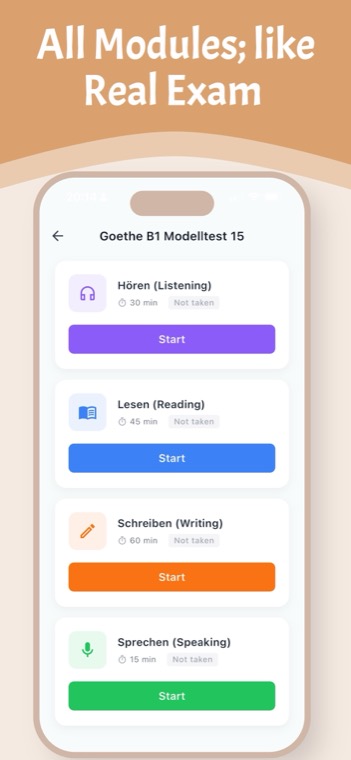
Model test in PassDeutsch showing the four Goethe exam modules with timers

In the app

What PassDeutsch gives you for Goethe

  • Full-length Goethe model tests at A1, A2 and B1 - each with all four modules
  • Exam timers per module so you learn to pace yourself before test day
  • AI marking for Schreiben with a score and point-by-point feedback
  • AI evaluation for Sprechen, part by part, with a total score out of 100
  • Goethe-style vocabulary lists for each level with games and spaced repetition
  • Analytics that show which module is costing you points

Preparation

Four things that move a Goethe score

Ordinary advice, in the order it pays off.

01

Sit one full test under exam conditions first

Before you study anything, take one complete model test with the timer running. The score is not the point - the point is finding out which of the four modules is weakest so you do not waste weeks polishing the skill you already have.

02

Learn the task types, not just the language

Goethe reading and listening tasks repeat the same handful of formats at every session. Once you recognise a matching task or a true/false trap, you read the question faster and spend your minutes on the German instead of the instructions.

03

Write to the word count, every time

Examiners award points for covering every bullet in the prompt, not for length. Practise hitting the required points inside the word limit - PassDeutsch counts your words and the AI tells you which prompt point you skipped.

04

Speak out loud from week one

Sprechen is the module most learners neglect and the one that is hardest to improve last-minute. Record yourself answering exam prompts and compare the feedback across attempts.

FAQ

Goethe questions

Can I prepare for the Goethe-Zertifikat with an app?

Yes - for the reading, listening and writing modules an app is close to ideal, because those modules are about task recognition, timing and accuracy. PassDeutsch adds AI marking for writing and speaking so you also get feedback on the two productive skills, which is normally the hardest part to practise alone. Pair it with speaking practice with a real partner or teacher before test day.

How many points do I need to pass the Goethe-Zertifikat?

Each module is marked out of 100 points and the pass mark is normally 60. At B1 the modules are certified individually, so you can pass Lesen, Hören and Sprechen and repeat only Schreiben. Confirm the current pass mark with your exam centre when you book.

Is the Goethe-Zertifikat harder than telc?

They test the same CEFR level and both are widely accepted, so neither is objectively harder. The differences are in the format: telc B1 has a Sprachbausteine (structures and vocabulary) section that Goethe does not, while Goethe B1 gives you three separate writing tasks. Prepare with model tests from the provider you have actually booked.

Does the Goethe-Zertifikat expire?

The certificate itself has no expiry date. Individual institutions, however, often ask for a certificate issued within the last one or two years, so check the requirement of the office or university you are applying to.

Keep reading

PassDeutsch is an independent study tool. It is not affiliated with, endorsed by, or connected to the Goethe-Institut, telc gGmbH, the Bundesamt für Migration und Flüchtlinge (BAMF), or any official examination body. Goethe-Zertifikat, telc Deutsch and DTZ are trademarks of their respective owners. Exam formats and requirements can change - always confirm the current specification with your test centre before booking.

Take a free Goethe model test

Two full model tests per level are included free - sit one under exam conditions and find out where you actually stand.

Free to download · All 210 model tests included · No card required