
Goethe-Institut
Goethe-Zertifikat B1
Modular - pass and repeat each of the four modules separately.
CEFR B1 · Intermediate
B1 is the level that changes your paperwork. It is the language requirement usually cited for permanent residence and naturalisation, for many apprenticeships, and for a great deal of ordinary working life in Germany. It is also the first level where the exam expects you to have opinions and defend them. PassDeutsch covers all three B1 routes - Goethe-Zertifikat B1, telc Deutsch B1 and the DTZ - because the format you practise should be the one you booked.
The CEFR describes each level by what you can do with the language, not by how much grammar you have covered. At B1 you can:
Exam grammar is not all of German grammar. This is the syllabus worth your study time at this level:
Your options
All of these certify the same CEFR level. Take the one the office, school or employer asking for it accepts.
Goethe-Institut
Modular - pass and repeat each of the four modules separately.
telc
Includes Sprachbausteine; the written part is one 150-minute block.
BAMF
The integration-course exam; certifies A2 or B1 per part.
Study plan
Assumes about an hour a day plus one full model test a week. Adjust the weeks, keep the order.
Weeks 1–2
Sit one complete timed model test in the format you booked. Write down your score per module. Everything after this is targeted at the two weakest modules.
Weeks 3–5
B1 reading is long. Practise skimming for the question, not reading for pleasure. If you are taking telc, drill Sprachbausteine daily - it is the cheapest score improvement available.
Weeks 6–8
One written task every other day: forum post, semi-formal email, complaint letter. Use the AI feedback to check task fulfilment first, grammar second.
Weeks 9–12
Record the three speaking parts twice a week and compare feedback. Alternate full model tests and error review until your scores stop moving - then book the exam.
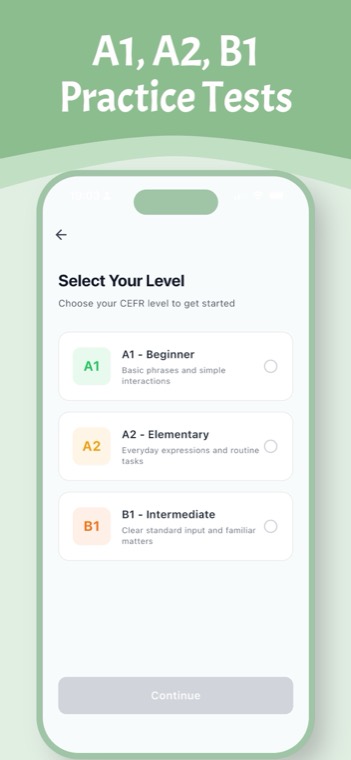
In the app
FAQ
Take the one the office or institution asking for it accepts. If you are in an integration course, that is the DTZ. If you need an internationally recognised certificate, Goethe-Zertifikat B1 travels furthest. If your school or employer names telc, take telc. All three certify B1; the formats differ, so practise the right one.
The B1 word lists run to roughly 2,400 words including the A1 and A2 vocabulary. More important than the count is range: at B1 you need words for opinions, problems and reasons, not just objects and routines.
Cumulatively, most providers plan 350 to 450 hours of guided learning from zero to B1. From a solid A2, expect three to five months of consistent study, and less if you are living in a German-speaking environment.
Yes. Goethe-Zertifikat B1 is modular: each of the four modules is certified separately, so you can repeat just the one you did not pass rather than the whole exam. telc and the DTZ are not modular in the same way.
B1 is the level usually required as proof of German for naturalisation, and a DTZ certificate showing B1 is commonly accepted. Requirements depend on your individual case and can change, so confirm with the authority processing your application.
PassDeutsch is an independent study tool. It is not affiliated with, endorsed by, or connected to the Goethe-Institut, telc gGmbH, the Bundesamt für Migration und Flüchtlinge (BAMF), or any official examination body. Goethe-Zertifikat, telc Deutsch and DTZ are trademarks of their respective owners. Exam formats and requirements can change - always confirm the current specification with your test centre before booking.
Download PassDeutsch, take a complete timed test in your exam format, and see your score per module.
Free to download · All 210 model tests included · No card required